The timeless wisdom inside a 100-year-old hotel
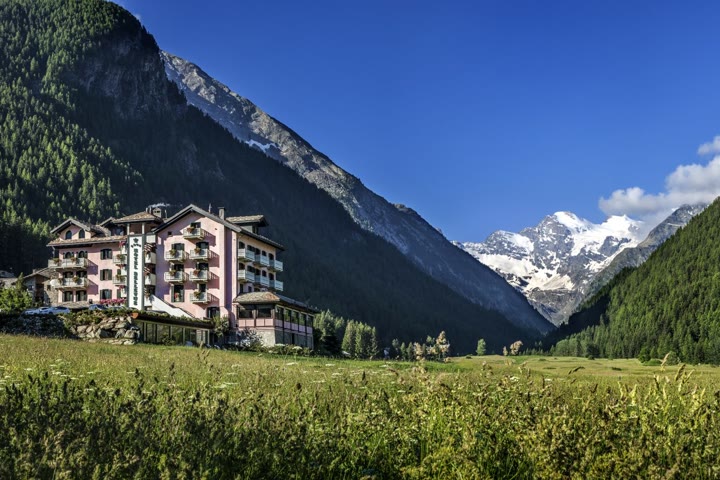
A couple of weeks ago, my wife and I took a trip through the Italian Alps, stopping for a couple of days in the town of Cogne, near the border with Switzerland. We stayed at a small, family-run hotel—founded in 1925—now in its fifth generation of stewardship. The door opened to our room, and we were greeted with this view.
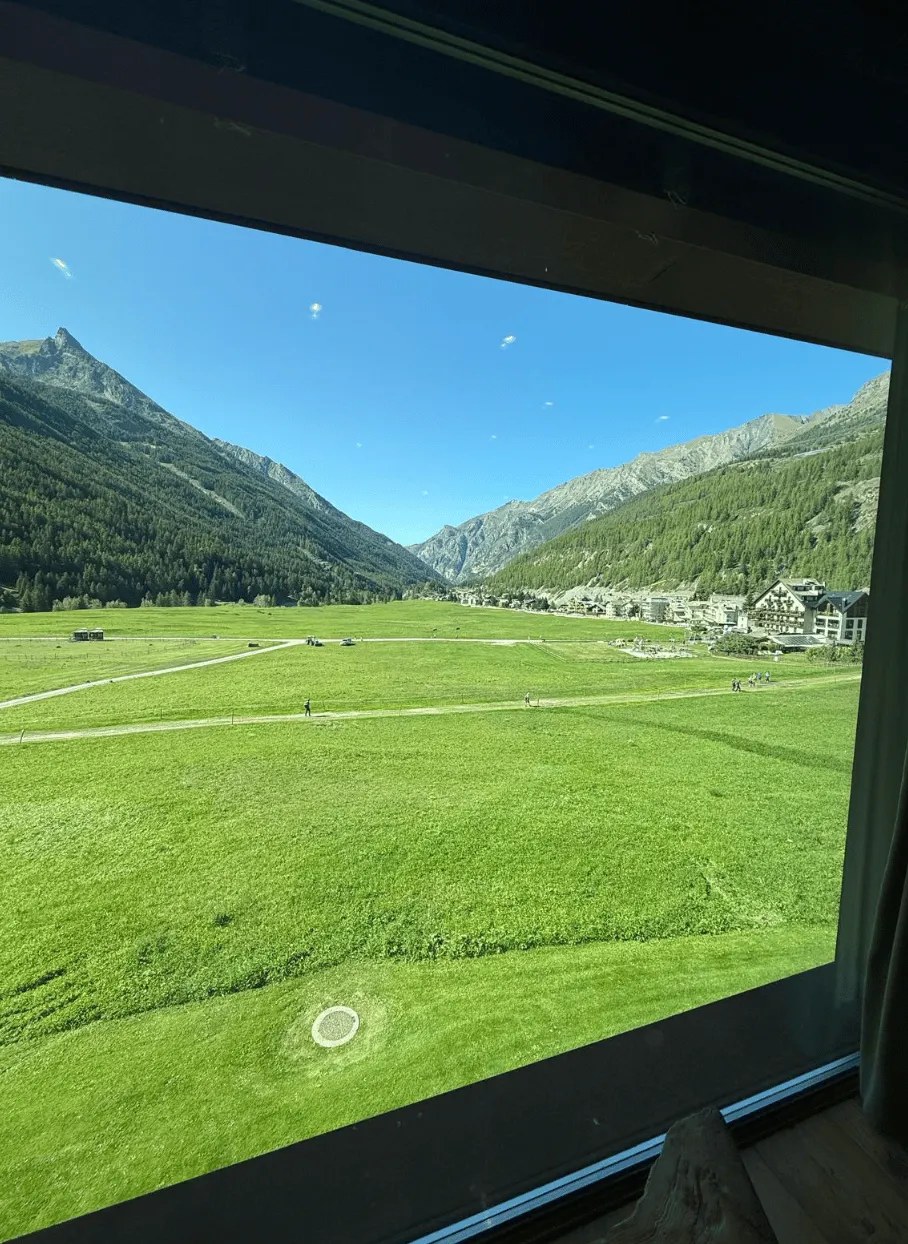
This million-dollar view—as incredible as it was—came with an unexpected surprise, especially for a value investor like me: the room itself cost far less than you might think. And despite a Michelin-starred restaurant and an outrageous basement spa, complete with a salt cave and hay biosauna, the hotel was priced at a level that felt almost unreasonably... reasonable.
And that, I’d soon learn from its fifth-generation steward, Pietro Imbimbo Roullet, was precisely the point.
During a tour of the hotel, Pietro explained that his family intentionally keeps prices below the stratospheric levels of many luxury hotels. Partly, this is because they don’t particularly want to attract the kind of ultra-fussy guest drawn to ultra-luxury hotels. Pietro mentioned one American guest who demanded caviar at 3 a.m., flustering him—and his employees.
“I told him all my staff was sleeping,” he told me. “So the answer was no.”
Their pricing also reflects a deeper philosophy about the family’s relationship with money itself—and the purpose of their business.
While the family pays itself modest salaries, they reinvest the hotel’s profits back into the property—and the people who work there. Employees are provided lodging and meals at no cost. The family has little interest in maximizing what can be extracted from each room or each guest. Instead, the purpose of the hotel—in Pietro’s mind, at least—is how much the business can give.
Every piece of furniture and art, for instance, is personally sourced by members of the family from around the world. My wife and I slept in a 15th-century four-poster bed. Sculptures from the 12th and 13th centuries abound throughout the hotel. Staying there felt kind of like being invited into the home of an eccentric, exceptionally well-traveled art collector. (Though I missed my kids, I was glad they weren’t there to topple some Renaissance-era statue.)
I have no commercial interest in promoting this hotel. I’m just a fan, and we had a lovely time. But I do have a vested interest in exploring the philosophy behind this particular way of doing business—a mindset that, I think, has become increasingly rare.
* * *
For decades, we’ve come to think of economics as a predictable science.
Its most basic principle—prices responding to supply and demand—is treated almost like a law of nature. Scarcity drives prices up; excess supply pushes them down. How could it be otherwise?
Nowhere do we experience this more viscerally than in travel. Try booking a plane ticket on a busy holiday weekend, or reserving a hotel room in Boston during freshman move-in week. Yikes.
But we mostly shrug it off. That’s just the way it works.
Dynamic pricing is rational behavior, at least in the short term. If thousands of people suddenly want something and there is only a finite amount of it available, why wouldn’t a business charge more? Hotels and airlines offer some of the most obvious examples, but the same logic increasingly pervades everything from software to restaurants to education to retail to entertainment.
If a company can extract a little more from a customer, the logic goes, why wouldn’t it?
It seems inevitable, no?
And yet.
What seems perfectly rational in the short term can, very often, look deranged when you expand your sense of time.
Because the more you extract and take and—frankly—piss off your customers and employees, the less likely they are to return—or to tell anyone else that they should. You may maximize profit in the short term, but in doing so, you can make the business remarkably fragile: customers become transactional, employees have less reason to stay, loyalty disappears, and the mindset of relentless “optimization” becomes a cancer throughout the organism.
Increasingly, though, I believe the opposite is also true: give people more than they expect, and something intangibly wonderful begins to accumulate. A little inefficiency—a little slack, a little restraint, a little non-optimization—can be good, too. Time becomes your friend, and compounding does its magic. These behaviors give an organization a sense of purpose—maybe even a soul—and allow something wonderful to take root, deep beneath the surface.
Eventually, it starts to look something like resilience.
To lay my cards on the table: I’m increasingly skeptical of the idea that economics can be understood purely as a science. Business is simply too complex and too dependent on relationships to reduce entirely to equations about rational actors maximizing utility.
Instead, I’ve come to think of economics as something closer to a philosophy: a way of seeing the world, and deciding what—and how—we choose to value.
Consider, again, Pietro’s hotel.
A profit-maximizing mindset would naturally see an extraordinary opportunity to make more money. Between the spectacular Alpine view, wealthy international guests, and a Michelin-starred restaurant, the “obvious” move would be to charge as much as the market would bear. Perhaps $2,000 per night? Maybe $3,000?
In any given year, yes, the business would make more money. But what happens over a decade? A century?
What happens when you intentionally leave some money on the table? When guests repeatedly leave feeling they received more than they paid for? When you price the hotel not simply to attract the highest bidder, but to cultivate the kind of guests who appreciate the place? When employees are given meals and a place to live? When profits that could have been distributed to owners are instead used to buy art, improve the property, maintain the building, or simply make the experience a little more... extraordinary?
Those choices create value, too.
We just have a harder time putting a price on it.
* * *
The words hotel and hospitality share an ancient linguistic ancestor: the Latin hospes, a word that could refer to both a host and a guest.
Embedded in this word is an idea of reciprocity: a relationship between people connected by mutual obligations of generosity and care.
It would be tempting to see this little anecdote about a small, century-old Alpine hotel as simply a quaint family-business story. But I think it’s a larger allegory for how we think about long-term value creation, meaning, purpose, and how to make a business more resilient through acts of restraint and love.
If the Outlast journey has taught me anything, it’s that our economic models—and the language we use to describe business itself—so often struggle to capture a very basic truth: to survive for a very long time, you have to give more than you take.
The returns on that generosity are difficult, if not impossible, to model on a spreadsheet. When you give employees more than you technically have to, or give customers more value than the price they paid, you create loyalty. And when you treat people with care, they tell other people. Those people tell others.
That’s the best kind of marketing—the kind you simply cannot buy with a Google ad. These ripples spread outward and, like the roots of an ancient tree, they tend to make the entire business hardier with time.
* * *
On our final night at the hotel, my wife and I were finishing dinner when Pietro’s mother stopped by our table. She thanked us for staying with them and hoped we’d had a lovely time.
We had.
And she hoped we would come back.
I have no idea when—or if—I’ll find myself in Cogne again.
But if I do, I know where I’ll stay.
And if you happen to get there before me, say hello to Pietro. There’s a good chance he’ll be there on Sunday, walking guests through the halls, pointing out centuries-old furniture and art, and telling stories about the strange, beautiful hotel his family has spent the past hundred years keeping alive.
Eric
This essay first appeared in The Outlast Journal. Read the original.